Edinburgh · Scotland
Greyfriars Kirkyard
Few burial grounds in Britain combine the density of carved memorial sculpture, Covenanting history and urban-pollution exposure found in Greyfriars Kirkyard. Our work here addresses the specific decay patterns of Craigleith and Binny sandstone in a tightly enclosed Old Town setting.
Heritage Context
About Greyfriars Kirkyard
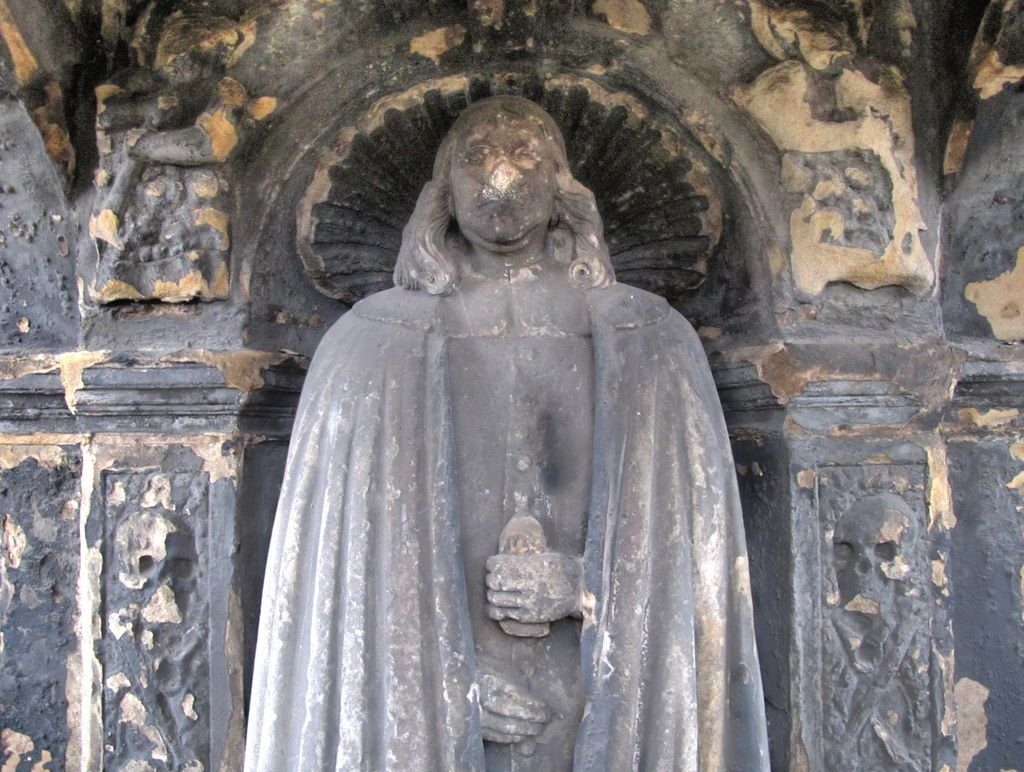
Established in 1561 on the site of a Franciscan friary, Greyfriars contains one of Scotland's most important collections of 17th and 18th-century funerary sculpture — including elaborate wall monuments, table tombs and the only surviving group of mort-safes still in situ.
The kirkyard sits within the Old Town World Heritage Site and is bordered by tenements, the National Museum of Scotland and George Heriot's School. Air pollution, salt-laden rain and biological colonisation have accelerated surface loss on the soft local sandstones.
The Covenanters' Prison at the south-west corner — a Category A scheduled monument — presents particular conservation challenges, with structural movement, mortar failure and weathered inscriptions documenting one of the darkest episodes of the 1670s.
Conservation Challenges
What we encounter in Edinburgh
Sandstone Surface Loss
Soft Craigleith stone suffers granular disaggregation, contour scaling and loss of carved detail from acid-rain weathering.
Iron Mort-Safe Corrosion
Cast and wrought iron mort-safes set into stone bases cause oxide-jacking and fracture of the surrounding fabric.
Biological Colonisation
Algal, lichen and ivy growth retain moisture against the stone and obscure inscriptions critical to genealogical and historical interpretation.
Mortar Failure
Cement repointing from 20th-century interventions traps moisture and accelerates decay around the wall monuments.
Inscription Legibility
Many of the 17th-century inscriptions are now barely readable and require careful recording before any treatment is undertaken.
Our Approach
How we work here
We begin every Greyfriars commission with high-resolution photogrammetric recording so that surface detail and inscriptions are archived before any intervention takes place.
Stone consolidation uses ethyl-silicate systems compatible with Edinburgh sandstone, applied only after biological growth has been gently removed using non-ionic biocide systems trialled on test panels.
All works are coordinated with Edinburgh World Heritage, the City of Edinburgh Council and Historic Environment Scotland under the appropriate scheduled monument and listed building consents.
Notable sites & features
- Covenanters' Prison (scheduled monument)
- George Mackenzie Mausoleum
- Adam Bothwell wall monument
- James Borthwick of Stow memorial
- Greyfriars Bobby grave marker
Relevant services
Frequently asked
Do you need permission to work on memorials in Greyfriars Kirkyard?
Yes. Most monuments are listed and the Covenanters' Prison is a scheduled monument. Works require listed building consent or scheduled monument consent, plus burial-ground permissions from the City of Edinburgh Council. We manage all applications end-to-end.
What is the typical timescale for a single memorial conservation?
From initial inspection to completion, individual wall monuments typically run six to twelve months, with most of that time spent on assessment, recording and consents rather than on-site works.