Edinburgh · Scotland
Edinburgh Old Town
Inscribed by UNESCO in 1995, the Old Town is a working medieval city of tenement closes, 17th-century lands and 19th-century improvements layered onto a defensive ridge. Conservation here is rarely about a single building — it is about how one façade affects three neighbours and a public route walked by millions.
Heritage Context
About Edinburgh Old Town
The Old Town's tightly-packed grain runs from Edinburgh Castle east along the Royal Mile to the Palace of Holyroodhouse, with steep closes and wynds descending to the Cowgate and the former Nor' Loch on either side.
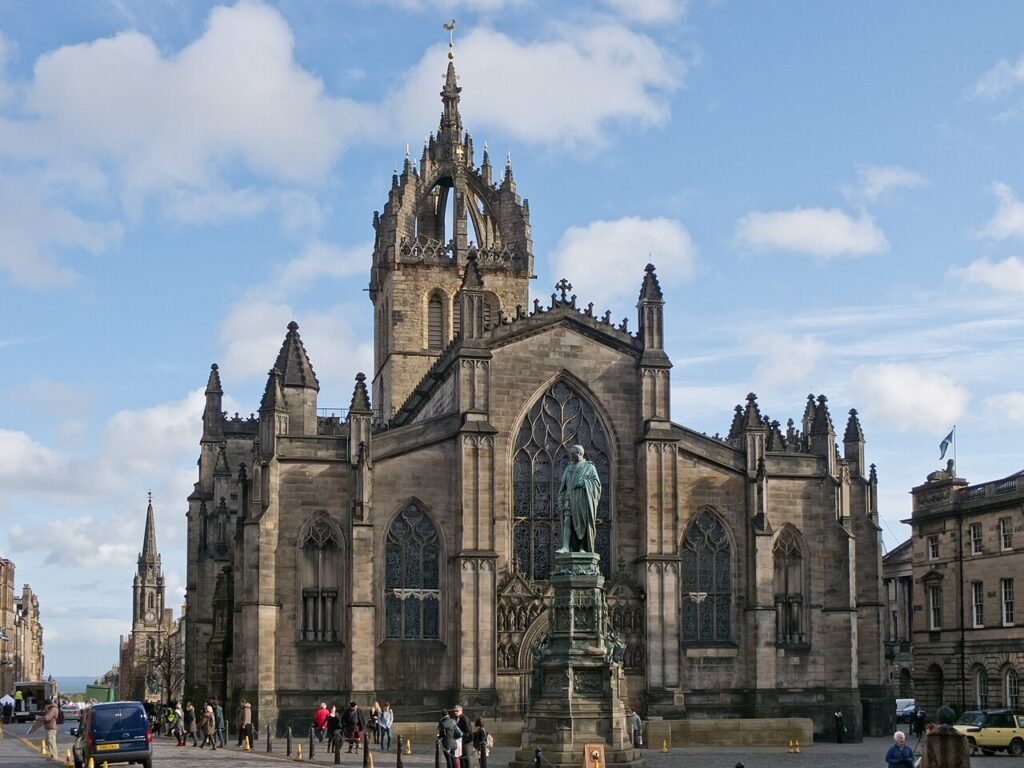
Most of the surviving fabric dates from the 17th to early 19th centuries, although some elements — including parts of St Giles' Cathedral and the Magdalen Chapel — are medieval. The dominant building stone is Craigleith sandstone, with Hailes, Binny and Cullalo also present.
The 2002 Cowgate fire and the 2018 Sauchiehall Street fire (in the neighbouring district) underscored how vulnerable dense historic urban fabric is to fire and water damage, and how slow and skilled the recovery must be.
Conservation Challenges
What we encounter in Edinburgh
Façade Decohesion
Multi-storey tenement façades suffer from open joints, stone slippage and the failure of historic iron tie-bars hidden within the masonry.
Stone Replacement Matching
The original Craigleith quarry closed in 1942, requiring careful geological matching from active quarries to maintain visual continuity.
Public-Realm Constraints
Working over busy pavements and shop-fronts on the Royal Mile requires scaffolding designs and permits that respect a UNESCO setting.
Fire-Recovery Conservation
Post-fire fabric needs careful assessment for thermal shock damage that may not be visually obvious for years after the event.
Rainwater Management
Failing cast-iron rhones, hoppers and downpipes are the single biggest preventable cause of stone decay in the Old Town.
Our Approach
How we work here
We work with the City of Edinburgh Council, Edinburgh World Heritage and Historic Environment Scotland to align façade-conservation proposals with the Old Town's UNESCO management plan.
Photogrammetric recording captures the existing fabric at high resolution before scaffolding is erected, giving every project a benchmark dataset that survives long after the works are complete.
Specifications favour traditional lime mortars, hot-mixed where appropriate, and replacement stone that matches the original geology rather than the closest commercial product.
Notable sites & features
- Royal Mile (High Street and Lawnmarket)
- St Giles' Cathedral
- Cowgate post-fire reconstructions
- Canongate tenements
- Old Town closes — Advocate's, Riddle's, Tweeddale
Frequently asked
What consents are needed to work on an Old Town tenement?
Most tenements are listed (frequently Category A or B) and all sit within the UNESCO World Heritage Site. Works typically require Listed Building Consent and sometimes Planning Permission, plus engagement with Edinburgh World Heritage as a statutory consultee.
Can you specify lime mortars compatible with original construction?
Yes. Mortar specification is based on analysis of the original binder and aggregate, with hot-mixed quicklime mortars used wherever the original construction supports it.
Featured Projects